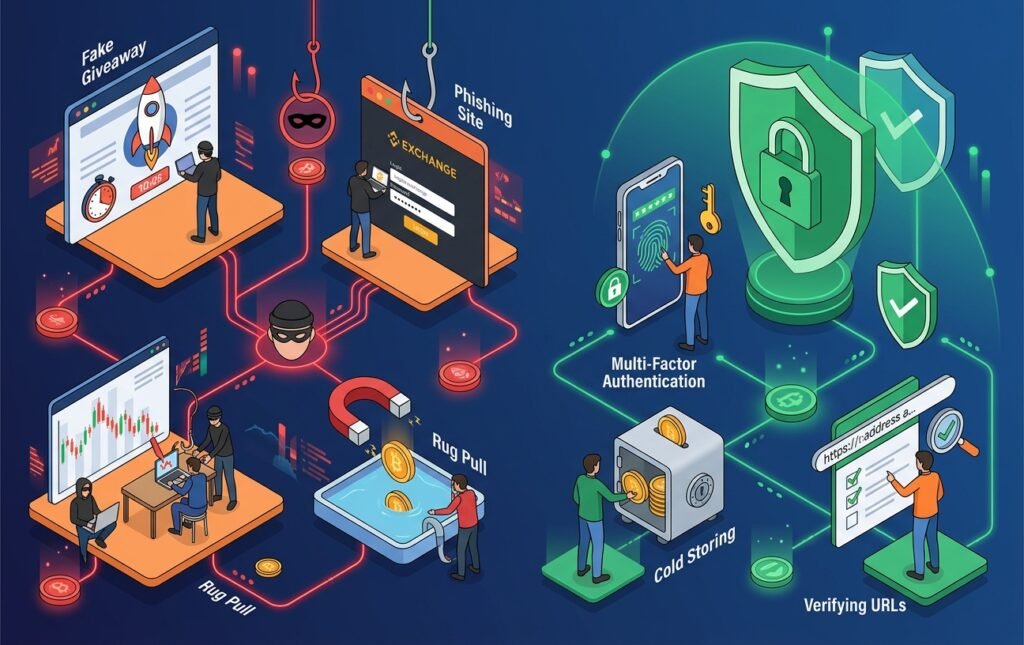

A fake crypto investment website can look surprisingly convincing, using professional branding, realistic dashboards and promises of attractive returns to persuade visitors to deposit money. Knowing how these platforms operate—and recognising the warning signs before sending cryptocurrency—can help protect you from a costly scam.
Fake investment websites are designed to create trust quickly. They may claim to offer cryptocurrency trading, automated investment strategies, staking, portfolio management or other digital-asset services. Some even imitate legitimate financial companies or use fabricated testimonials, licences and regulatory information.
The danger is that once a victim transfers crypto to the platform, recovering the funds can be extremely difficult or impossible.
This guide explains how fake crypto investment platforms work, the warning signs to look for, and what you should do if you think you have encountered one.
What Is a Fake Crypto Investment Website?
A fake crypto investment website is an online platform that falsely presents itself as a legitimate investment service.
The website may allow visitors to:
- Create an account
- Deposit cryptocurrency or fiat currency
- View an investment balance
- See supposed trading profits
- Select investment plans
- Contact customer support
- Request withdrawals
The problem is that the website may not be carrying out the investment activity it claims to perform.
In some cases, the numbers shown in a user’s account are simply fabricated. A dashboard might display growing profits even though no genuine investment has taken place.
The website’s purpose is usually to persuade the victim to deposit more money or cryptocurrency.
How Fake Crypto Investment Platforms Typically Work
Many scams follow a similar pattern.
1. The victim encounters an investment opportunity
The initial contact can happen through social media, messaging apps, online advertisements, search results, dating platforms or unsolicited messages.
The opportunity may be presented as a new crypto project, trading service or investment platform.
The message often creates a sense of opportunity or urgency.
2. The website creates an impression of legitimacy
After visiting the platform, the potential victim may see:
- Professional-looking branding
- Market charts
- Company information
- Customer testimonials
- Security claims
- Apparent regulatory details
- Investment packages
- A polished account dashboard
A professional appearance, however, is not proof that a company is genuine.
Scammers can copy design elements from legitimate businesses or create entirely convincing websites from scratch.
3. A small initial deposit may be encouraged
Some fraudulent platforms start by asking for a relatively modest amount.
This can make the opportunity feel less risky and give the victim confidence in the platform.
The account may then appear to generate profits.
4. The victim is encouraged to deposit more
Once the victim believes the platform is working, the scammer may encourage larger deposits.
The supposed account balance can continue increasing, creating the impression that the investment is successful.
5. Problems appear when the victim tries to withdraw
This is one of the most important warning signs.
The platform may claim that the victim must first pay:
- A withdrawal fee
- A tax
- A verification charge
- A processing fee
- A security deposit
- A compliance payment
The victim may be told that the money will be refunded or deducted from the withdrawal.
Instead, the scammer may simply demand another payment.
A request for additional cryptocurrency before releasing supposedly available funds should be treated as a major warning sign.
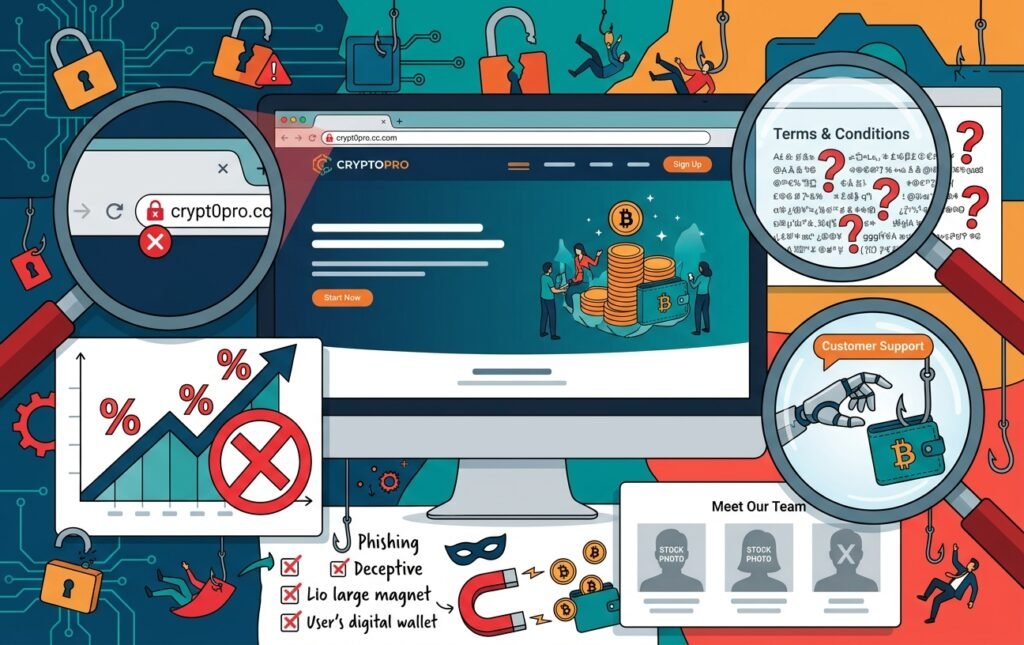
10 Warning Signs of a Fake Investment Website
No single warning sign proves that a website is fraudulent. However, several warning signs appearing together should make you stop and investigate before transferring money.
1. Guaranteed or Unrealistic Returns
Promises of guaranteed profits are a major red flag.
Crypto markets can be highly volatile. A legitimate investment provider should not need to promise that an investment will produce a fixed or guaranteed return simply to persuade you to deposit money.
Be particularly cautious of claims such as:
- Guaranteed daily profits
- Risk-free crypto investing
- Fixed returns regardless of market conditions
- Extremely high returns within a short period
- “Secret” strategies that supposedly cannot lose
If an opportunity sounds too good to be true, slow down rather than increasing your deposit.
2. Pressure to Invest Immediately
Scammers often use urgency to prevent potential victims from carrying out independent checks.
You might be told:
- “This opportunity expires tonight.”
- “Only a few investment places remain.”
- “You need to deposit now.”
- “The market opportunity will disappear.”
- “Your account will be closed if you don’t act.”
Legitimate financial decisions generally deserve time for research and consideration.
Pressure is not evidence of a genuine opportunity.
3. The Company Cannot Be Independently Verified
A website may provide a company name, office address and registration number. That information still needs to be checked independently.
Do not rely solely on information published by the website itself.
Look for evidence from reliable external sources, such as official company or regulatory records where applicable.
Pay attention to discrepancies between:
- The company’s stated name
- Its website domain
- Its registered business details
- Its contact information
- Its claimed regulatory status
A company having a registration somewhere does not automatically mean its investment service is authorised or legitimate.
4. Fake or Misleading Regulatory Claims
Some fraudulent websites display regulatory logos, licence numbers or claims of being “fully regulated.”
These claims should be independently verified.
A regulatory logo on a website is not proof of authorisation.
Where a platform claims to be regulated, find the relevant regulator independently and check whether the company and the specific service actually appear in its records.
Do not use a telephone number, email address or verification link supplied only by the investment website to confirm its own regulatory status.
5. The Website Domain Looks Suspicious
Check the domain carefully.
Scammers may use:
- Misspelled versions of legitimate company names
- Unusual domain extensions
- Newly created domains
- Domains that have no obvious connection to the claimed company
- URLs that differ from the legitimate company’s website by only a few characters
A secure connection indicated by “HTTPS” is not enough to establish that a website is legitimate. Fraudulent websites can also use encrypted connections.
6. Fake Testimonials and Reviews
Testimonials can be fabricated or copied from elsewhere.
Be cautious when every review is overwhelmingly positive, especially if testimonials:
- Use generic language
- Feature stock-style photographs
- Make unusually specific claims about profits
- Cannot be independently verified
- Appear only on the investment website
Search for independent information rather than relying on testimonials supplied by the platform.
7. The Platform Wants Crypto Sent to a Personal Wallet
Be extremely careful when an investment service asks you to send cryptocurrency directly to a wallet address controlled by an individual or an unrelated entity.
Before transferring crypto, understand:
- Who controls the receiving wallet
- Why the payment is required
- What service you are actually paying for
- Whether the destination matches the organisation you intended to use
Once a cryptocurrency transaction has been confirmed on a blockchain, reversing it is generally not like cancelling a card payment.
8. Customer Support Becomes Demanding or Threatening
A suspicious platform may initially provide friendly and responsive support.
Later, representatives may become increasingly persistent when you attempt to withdraw your funds.
They might tell you that you must pay another charge, provide additional personal information urgently or make another deposit.
Threats, intimidation and aggressive pressure are particularly concerning.
9. You Are Asked to Install Unnecessary Software or Share Sensitive Information
Be cautious if an investment website or supposed support representative asks you to install remote-access software, reveal wallet credentials or provide sensitive authentication information.
Never give another person your wallet recovery phrase or private keys.
A legitimate service should not need your private key or recovery phrase to “verify” that you own your cryptocurrency.
10. The Profits Only Exist Inside the Website
Perhaps the biggest question is whether the money shown on the platform can actually be withdrawn.
A dashboard displaying a large balance does not prove that the balance represents real assets.
If withdrawals repeatedly fail or require additional payments, stop sending money.
How to Check a Crypto Investment Website Before Depositing
Taking a few minutes to investigate a platform can help you avoid making an irreversible transaction.
Check the company independently
Search for the company outside the website itself.
Look for:
- Official business records
- Relevant regulatory registers
- Established industry reporting
- Independent security information
- Consistent contact details
- A credible history of operation
Do not assume that search-engine rankings prove legitimacy.
Verify regulatory claims
If the platform claims to be authorised or regulated, identify the relevant regulator independently and search its official records.
Check whether the authorisation applies to the specific company and activity being offered.
This distinction matters because a company may have some form of registration without being authorised to provide the investment service it is advertising.
Investigate the domain
Look carefully at the web address before entering personal information or connecting a wallet.
Check for subtle spelling differences and whether the domain appears consistent with the organisation’s established identity.
Look beyond the platform’s own reviews
Search for independent reporting and warnings.
A legitimate company will not necessarily have perfect reviews, and a scam can have hundreds of apparently positive testimonials.
The goal is to establish whether there is credible evidence behind the company’s claims.
Understand exactly where your money is going
Before making a deposit, you should be able to explain in simple terms:
Who receives my money, what service am I purchasing, where are my assets held, and how can I withdraw them?
If the answers are unclear, do not proceed until you have independently verified them.
Why Crypto Scams Can Be Difficult to Reverse
Cryptocurrency transactions can be difficult to reverse because blockchain transfers are generally designed to be final once confirmed.
That means a scammer may be able to receive cryptocurrency without having the ability—or intention—to return it.
This makes prevention particularly important.
A fake investment website can disappear, change its domain or stop responding after receiving funds. Even if the website remains online, the supposed investment balance may have no connection to actual assets.
This is one reason you should treat a request to send crypto as a significant financial decision rather than simply another online payment.
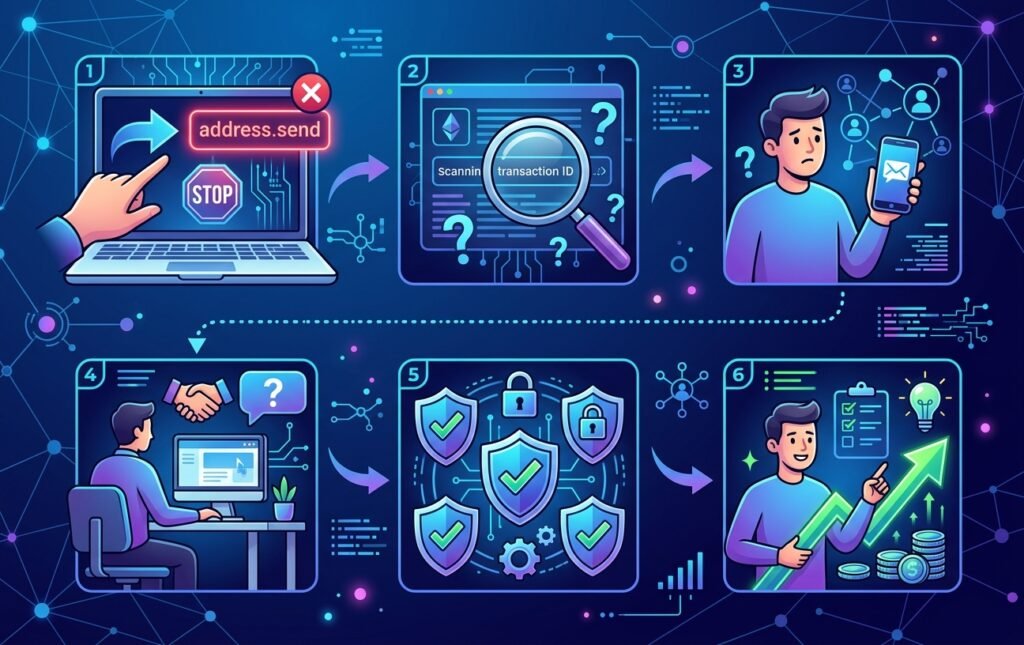
What to Do If You Think an Investment Website Is a Scam
If you suspect a platform is fraudulent, do not send additional money simply because someone promises that doing so will unlock your existing balance.
Take a step back and preserve relevant information.
Depending on the circumstances, useful records may include:
- Website addresses
- Emails and messages
- Transaction IDs
- Wallet addresses
- Screenshots
- Payment records
- Names and contact details used by the people involved
- Dates and amounts of transactions
If you connected a wallet or disclosed sensitive credentials, take appropriate steps to secure any remaining assets and accounts.
You should also consider reporting the incident to the relevant authorities or platform involved in the transaction.
Be especially careful of “recovery” scams
After losing money, victims may be contacted by people claiming they can recover the cryptocurrency for an upfront fee.
This can become a second scam.
Be suspicious of anyone who:
- Guarantees recovery
- Claims to have special access to a blockchain
- Demands cryptocurrency upfront
- Contacts you unexpectedly about recovering your funds
- Claims to be working with law enforcement without verifiable evidence
- Asks for wallet recovery phrases or private keys
No legitimate recovery service can guarantee that lost or stolen cryptocurrency will be returned.
How to Protect Yourself From Fake Investment Platforms
The strongest defence is to slow down before transferring money.
A few practical habits can make a significant difference:
Verify before you deposit.
Check the company, regulatory claims and domain independently.
Never invest because someone is pressuring you.
Urgency is often used to prevent careful investigation.
Treat guaranteed returns with extreme caution.
There is no reliable way to eliminate investment risk simply by using a particular platform.
Keep control of sensitive wallet credentials.
Never disclose private keys or recovery phrases to an investment platform or supposed support agent.
Understand the withdrawal process before depositing.
Know what fees, requirements and restrictions genuinely apply.
Don’t trust a dashboard simply because it looks professional.
A displayed balance is not proof that real assets exist.
Be suspicious of requests for additional payments.
Especially when a platform claims you must pay more crypto before you can withdraw your own funds.
The Bottom Line
Fake investment websites are designed to make fraudulent opportunities look legitimate. A polished interface, impressive returns, regulatory logos and convincing customer support do not prove that a crypto investment platform is genuine.
The safest approach is to verify claims independently, avoid pressure-driven decisions and understand exactly where your cryptocurrency is going before you send it.
If a platform promises unusually high or guaranteed returns, makes withdrawal conditional on further payments, or discourages you from carrying out independent checks, treat those signs seriously.
With cryptocurrency, prevention matters because a transaction sent to a scammer may be extremely difficult to reverse.
Important Notice: This article is provided for general educational and informational purposes and should not be considered financial, legal, security or investment advice. Cryptocurrency transactions and digital assets involve risks, and information should be independently verified before taking action. Voyallet does not guarantee the recovery of lost or stolen assets and is not responsible for losses resulting from actions taken based on this information.